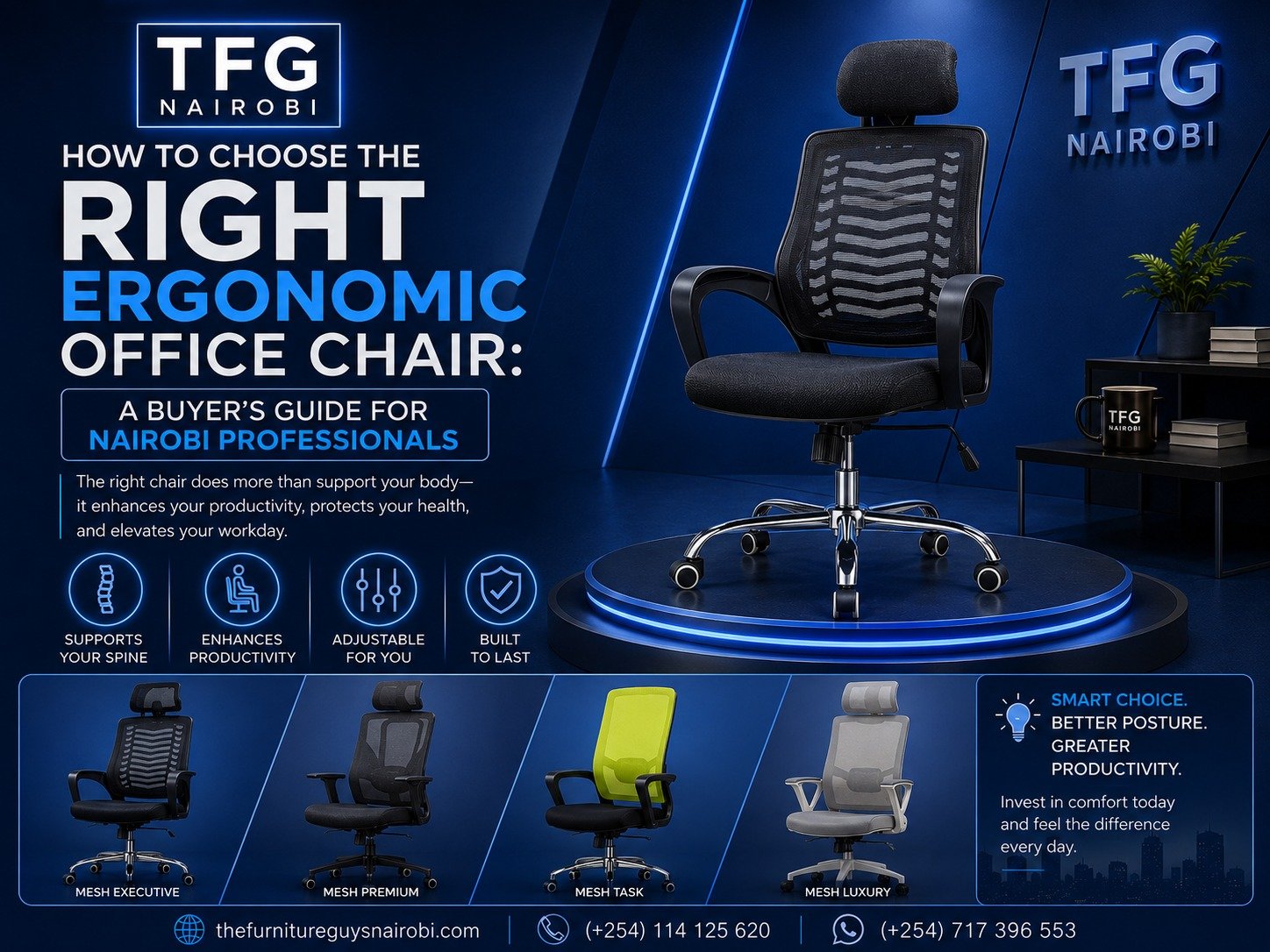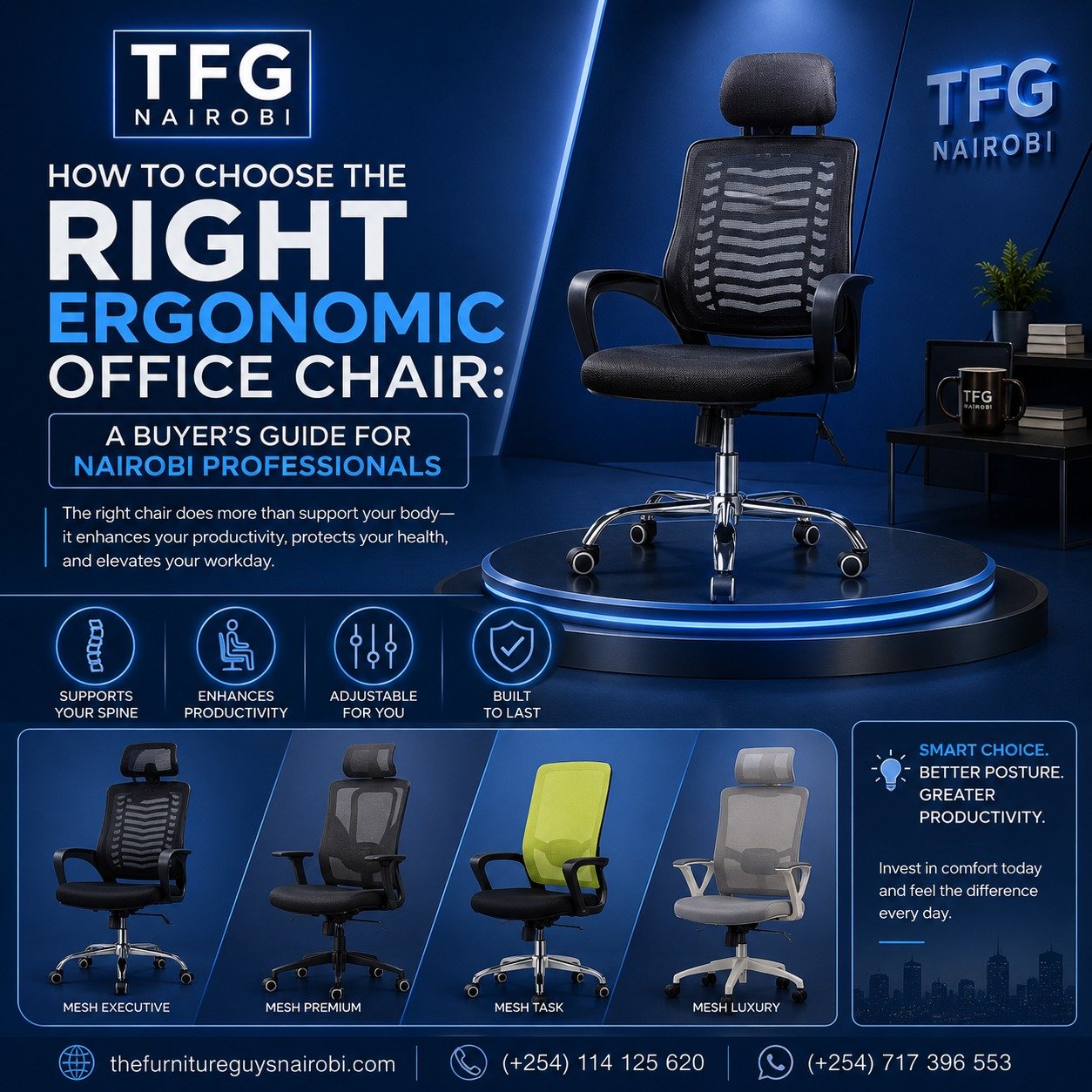
If you spend six, eight, or ten hours a day sitting at a desk, your chair isn’t a small decision — it’s one of the most important pieces of furniture you’ll buy. A poorly designed chair doesn’t just feel uncomfortable by 3 pm; over months and years, it contributes to back pain, poor posture, and afternoon fatigue that quietly drags down your focus and productivity.
The good news: choosing the right ergonomic office chair doesn’t have to be complicated once you know what to actually look for. This guide breaks down the features that matter, the different chair types available, and how to match a chair to your budget and your workday — with real recommendations from our range at TFG Nairobi.
Why the Right Office Chair Actually Matters
A well-designed chair supports the natural curve of your spine, keeps your shoulders relaxed, and lets your feet rest flat while your knees stay at roughly a right angle. Get this wrong, and your body compensates — slouching, leaning, or tensing muscles that were never meant to hold you up all day.
The payoff for getting it right is real: better posture, less end-of-day fatigue, and the ability to actually focus through a full workday instead of shifting in your seat every twenty minutes. For remote workers and office-based professionals alike, this is one of the highest-impact, lowest-effort upgrades you can make to your workspace.
Key Features to Look For
Lumbar Support
This is the single most important feature in any ergonomic chair. Lumbar support cradles the inward curve of your lower back, preventing the slouched posture that leads to lower back strain. Look for chairs with built-in lumbar support woven into the backrest, or better yet, an adjustable lumbar dial that lets you fine-tune the support to your own spine.
Adjustable Headrest
A headrest isn’t just for napping — it supports your neck and upper back during long calls, video meetings, or moments when you lean back to think. The best headrests adjust in both height and angle, so they actually meet your head rather than forcing your neck into an awkward position.
Tilt and Recline Mechanism
Not all “tilt” is created equal. A basic tilt-lock chair rocks back a few degrees and locks in place. A genuine recline mechanism — especially one with pneumatic tilt control that adjusts resistance to your body weight — lets you shift positions throughout the day, which matters more than people expect. Sitting in one fixed position for hours is itself a strain, even in a “good” chair.
Armrests
Firm, supportive armrests reduce shoulder and wrist strain, especially if you type for long stretches. The best chairs offer 3D or 4D adjustable armrests — height, depth, width, or angle adjustment — so your arms rest naturally instead of forcing your shoulders up or out.
Material: Mesh vs. Leather/PU
This is where Nairobi’s climate genuinely matters. Breathable mesh backrests promote airflow and stay cool through warm afternoons, making them a strong pick for most home and office setups here. Leather or PU leather chairs bring a more executive, boardroom look and are easy to wipe clean, but can feel warmer over long sitting sessions. Neither is objectively “better” — it depends on your priorities: comfort-in-heat versus polished appearance.
Base and Mobility
A sturdy 5-star base (metal or chrome) with smooth-rolling casters and full 360° swivel lets you move freely around your desk without straining to reach things. This matters more than people realize, especially if your desk setup spans a monitor, a keyboard tray, and reference materials.
Chair Types Explained
- Low-back mesh chairs — Compact, breathable, budget-friendly. Good for home offices, smaller desks, or anyone who doesn’t need a headrest.
- Mid-back chairs — A step up in back coverage and support, often with lumbar support built in. A solid middle-ground choice for most professionals.
- High-back ergonomic chairs — Full spine and neck support with an adjustable headrest. Best for people who sit for long, uninterrupted hours.
- Premium ergonomic office chairs — The top tier: full recline (often up to 135°), multi-directional armrests, adjustable lumbar dials, and premium build quality. Designed to rival the best ergonomic chairs on the market.
- Executive leather chairs — Leather or PU leather finish with a high-back silhouette, built for boardrooms, private offices, and client-facing spaces where appearance matters as much as comfort.
Budget vs. Premium: What You Actually Get for More Money
A budget chair (roughly KSh 8,000–15,000) typically gives you a solid mesh back, basic tilt, and a functional 5-star base — genuinely good value for light-to-moderate daily use. Step up into the KSh 15,000–30,000 range, and you’ll usually gain adjustable lumbar support, a proper headrest, and sturdier build quality. Premium chairs (KSh 30,000+) add genuine engineering: full recline mechanisms, multi-directional armrests, pneumatic tilt tension control, and aluminum bases built for years of daily commercial use.
The right choice isn’t always “buy the most expensive chair” — it’s matching the chair to how many hours you actually sit, and what specifically bothers you about your current setup.
Our Recommendations by Use Case
Best budget pick for home offices: The FS5003 High-Back Office Chair offers an adjustable headrest, built-in lumbar support, and a high-density plush cushion — genuinely capable ergonomic features at an accessible price point.
Best Ergonomic Office Chair for long working hours: Our premium ergonomic mesh chair (model J216A) is built for people who need real rest breaks built into their workday — full recline up to 135°, adjustable lumbar support, and 3D adjustable armrests. If you’re at your desk eight-plus hours a day, this is the tier worth considering.
Best compact option for smaller desks: Our low-back mesh office chair — available in Black, Red, Sky Blue, and Lime Green — brings tilt and height adjustment, a breathable mesh back, and BIFMA/SGS certification in a smaller footprint, ideal for tighter home office setups.
Best mid-range all-rounder: The FS4005 Mid-Back Office Chair balances built-in lumbar support and 360° swivel mobility at a genuinely accessible price.
Best for a boardroom or executive office: The BONZU Executive High-Back Office Chair in leather brings executive presence with built-in lumbar support and a five-star base — the kind of chair that makes an impression in client-facing spaces.
Best for visitor or reception seating: The 8003-3 Visitors Chair offers a breathable mesh back on a durable chrome cantilever frame — practical, comfortable seating for guests without the cost of a full ergonomic chair.
Frequently Asked Questions about Ergonomic Office Chair Nairobi
Q: What’s the single most important feature in an ergonomic office chair? A: Lumbar support. It has the biggest direct impact on posture and lower back comfort during long sitting sessions.
Q: Is mesh or leather better for Nairobi’s climate? A: Mesh generally performs better for everyday comfort in Nairobi’s warmer months, since it promotes airflow. Leather offers a more polished, executive look but can feel warmer over long sessions.
Q: Do I need a headrest on an ergonomic office chair? A: If you spend long hours on calls or lean back to think, yes — a headrest meaningfully reduces neck strain. If you sit upright most of the day, it’s a nice-to-have rather than essential.
Q: How much should I spend on an ergonomic office chair? A: It depends on your hours. Light use (a few hours a day) is well served by a budget chair. Full-time desk work (six-plus hours daily) justifies investing in a mid-range or premium chair with proper lumbar support and recline.
Q: Can I get office chairs delivered across Nairobi? A: Yes — TFG Nairobi delivers across Nairobi and surrounding areas, from Parklands to Karen, Westlands to Kilimani.
Looking for the right chair for your workspace? Browse our full range of office chairs or get in touch with TFG Nairobi for personalized recommendations based on your budget and daily hours at the desk.